Dorrigo Evans—Jack Rainbow
The Narrow Road to the Deep NorthDorrigo Evans’s relationship with Jack Rainbow is that of a doctor and patient, tested by repeated operations under extreme scarcity and finally marked by a death Dorrigo cannot prevent. Jack’s worsening condition turns medical care into a sequence of urgent decisions: Dorrigo amputates, confronts the limits of what can be done, and attempts a further operation with improvised equipment. The immediate hope that Jack will survive gives way to a loss that continues to trouble Dorrigo long after the war.
A doctor and patient on The Line
Jack comes to Dorrigo in the ulcer hut, where patients lie on bamboo platforms and treatment is limited by the camp’s conditions. Dorrigo has already operated on him twice. The first operation removed Jack’s right leg below the knee after an ulcer reached the shin and anklebone; when gangrene later developed around the stump, Dorrigo amputated again, this time high on the thigh. Three weeks later, Jack is brought back to him.
Their connection is not presented as a friendship formed through shared conversation or a remembered life before the camp. It is established through the repeated intimacy of medical care: Dorrigo has treated Jack before, knows the history of his condition, and must make another decision when that treatment has failed. The return of the same crisis makes Jack both a patient in immediate need and a measure of how little Dorrigo’s skill can guarantee amid deprivation.
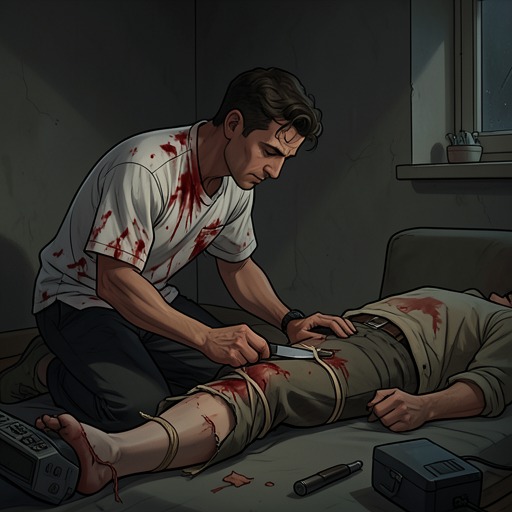
Dorrigo initially meets the patients with the sociability of someone greeting old acquaintances, but that manner falters when he sees Jack. He examines the remaining stump and recognizes that the infection has returned. The sutures used to close the femoral artery appear to have failed, and blood loss makes the situation urgent. Dorrigo calls for a tourniquet, then realizes that the ulcer hut has none. He uses his own belt instead, tightening it around Jack’s thigh to slow the bleeding. Jack is weak enough that he cannot drink unaided when an orderly offers water.
The operation and its reversal
Dorrigo orders another amputation. Squizzy Taylor questions whether Jack can survive the proposed operation, observing that even modern hospitals find removal at the hip dangerous; Dorrigo answers that Jack will die if they do nothing. Their exchange sets the practical stakes without making the operation a confident display of mastery: intervention may kill Jack, but doing nothing leaves him with no chance.
The available tools and materials shape what Dorrigo can attempt. An orderly hands him a kitchen meat saw, and the surgical team works by fading torchlight. Dorrigo uses gut twine prepared by Van Der Woude from pig intestine casings to sew the femoral artery. The material has been cleaned and boiled repeatedly, but it is still coarse compared with a surgical ligature. In this setting, medical care depends on improvisation, concentration, and the uncertain ability of improvised means to hold.
For a time, the operation seems to succeed. The bleeding stops, and Dorrigo completes the work of preparing the stump. Squizzy assists, and Dorrigo believes Jack will live. He imagines Jack years later, middle-aged, with children and his stump resting on a cushion. This imagined future is not a certainty; it is the possibility that gives the operation meaning for him. For a moment, Dorrigo feels that he has not failed and that his work has a purpose.
That hope reverses when fresh blood appears and the wound continues to ooze. The sutures holding the artery have given way. Dorrigo calls for the spoon used in the operation and tries to reach the artery again, while Squizzy attempts to control the bleeding. In the confusion and dim light, Dorrigo can no longer find tissue that will hold the thread. He keeps working and urging Squizzy to press harder, but the stitches will not hold. The operation has shifted from a difficult attempt to save Jack into a struggle against a failure Dorrigo cannot overcome.
Jack’s death and Dorrigo’s persistence
Dorrigo’s outward steadiness contrasts with his inner distress. He continues to work as Jack’s condition worsens, concentrating on the stump and trying to find a way to secure the artery. Jack says that he is cold. Dorrigo remains focused on the task, even as the attempt to save him becomes increasingly hopeless. The contrast matters to their relationship: Dorrigo’s persistence is an expression of care, but it cannot make care equivalent to control.
At last, Dorrigo finds the artery and works carefully to make the repair hold. Only when he raises his head does he understand that Jack has already been dead for several minutes. No one has known how to tell him. The delay between Jack’s death and Dorrigo’s recognition gives the scene its final reversal: the technical task continues after its purpose has become impossible, and Dorrigo’s concentration cannot restore the future he had pictured. The death is not framed as a lack of effort. Rather, it exposes the distance between Dorrigo’s determination to save a patient and the conditions that limit what he can do.
The loss after the war
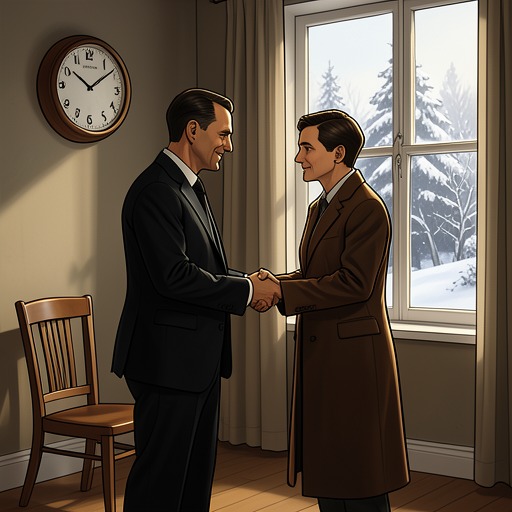
Jack’s death remains present for Dorrigo after his return to Australia. Some months after his honeymoon, he receives a letter from Bonox Baker saying that no one appears to have visited Jack’s widow. John Menadue has Jack’s medals to give her but has not done so. Dorrigo takes an ANA flight to Hobart, then travels out to the widow’s home near Neika. This journey is prompted not by a new medical emergency but by an unfinished responsibility to the person Jack left behind.
On the journey through snow, Dorrigo tries to imagine whether there was another way to stop the femoral artery from emptying. His fingers move as if testing a solution, but they meet only emptiness. The remembered problem is specific: not an abstract regret about war, but the operation he performed and the moment when the repair failed. The recurrence of that question shows how Jack’s death persists in Dorrigo’s mind as a practical problem with no answer, even though the operation is over.
At the farm, Dorrigo gives Jack’s widow what he calls the right things, but recognizes that he is lying to her. She listens and eventually says that she never really knew Jack and would have liked to. Her grief concerns the life and person she did not have the chance to know; Dorrigo’s is bound to the patient he tried to save and the failure he keeps revisiting. Their encounter brings the two absences together without resolving either. The medals and the visit acknowledge an obligation neglected by others, while Dorrigo’s continued search for a different surgical outcome shows that the obligation to Jack has never ended for him. Through this relationship, the novel makes care both concrete and limited: Dorrigo acts, improvises, and persists, but neither technical effort nor later remembrance can undo Jack’s death.